Grade 3 Lesson 12, about the Báb, was one of those lessons. Creating a new set of JustusCrafting resources always begins with the lesson itself. Each lesson brings its own stories, details and possibilities, and sometimes the development process reveals things that weren’t immediately obvious at the beginning.
Grade 3 Lesson 12, about the Báb, was one of those lessons.
Starting with a Very Detailed Story
When work began on the Grade 3 Lesson 12 resources about the Báb, one of the first things that stood out was just how much information there was in the story.
There were names and places that many Grade 3 children may not have encountered before. They may have heard of Iran, but Shíráz is a much more specific place. There were also names such as Quddús and Mullá Ḥusayn that may be unfamiliar to children, even if they have heard other names from stories before.
The story also felt quite different from some of the earlier lessons. Rather than moving fairly quickly through the life of a Manifestation — from birth, through the early years and recognition of His mission, to teaching, difficulties and the spread of His Message – the story of the Báb is much more detailed.
There are many people, places, journeys and events, with many things happening one after another.
Interestingly, the extent to which the story lent itself to sequencing did not become apparent right away. It emerged during the development of the workbook.
Working through the lesson page by page meant taking sentences directly from the story and using them as a starting point for the context on each activity page. Sometimes a sentence needed to be shortened so that it would fit comfortably on the page, but without removing important information or changing the wording very much.
As this process continued, it became clear just how much information could be contained in only a few sentences. And within that information were many sequences of events that could be turned into activities.
The activities do not lead the story. The story guides the activities.
If you’d like to explore the resources created for Grade 3 Lesson 12, you can find them on the Grade 3 resource page.
When Sequencing Starts Showing Up Everywhere
As the workbook developed, the amount of sequencing in the story became more and more noticeable. One page might naturally lend itself to putting events in order, and then a few pages later another part of the story could do the same thing.
That raised a practical design question: How can the same type of information be presented without making the activities feel repetitive?
The easiest solution would have been to put each set of events into a series of boxes and have children label them in order. But that would quickly become predictable, especially within the same workbook.
So different approaches began to emerge.
In one activity, symbols were placed directly into the context sentences. Children could read through the information, find the symbols, and then record the event connected with each one. The sequencing was still there, but the activity required children to go back into the context and search for the information rather than simply moving prepared statements into order.
The journey from Mecca to Medina offered another possibility. Rather than presenting the events as another set of numbered boxes, the movement through the journey became part of the activity itself. A visual map could show the progression from one place to another, with the information placed along the route.
The type of thinking was still connected to sequence, but the experience of working with the information was different.
But the process was not always that neat.
Sometimes a page would be finished and feel good enough, but not quite right. The information was there and the activity worked, but something about the presentation still felt too familiar. Rather than forcing an idea that wasn’t quite satisfying, the page could be left and returned to later — during another pass through the workbook, after working on something else, or even the next day.
And sometimes that is when the spark appears.
A different way of looking at the same information suddenly makes sense. An activity that initially seemed like another straightforward recall exercise might reveal an opportunity for children to search the context for information, connect several details, or approach the same material visually.
That moment – when something that had been frustrating suddenly turns into “Oh! This could work!” – is one of the most enjoyable parts of creating the resources.
There were quite a few moments during the development when the question became, “Is this too much like something already on another page?” Going back and comparing the pages helped determine whether an activity needed to be changed.
The goal wasn’t to avoid sequencing. Sequencing was genuinely part of the story. The challenge was finding different ways for children to work with that information.
And that distinction is important. An activity can look different on the page, but if children are always being asked to think in exactly the same way, the visual variety only goes so far. Finding different ways to approach the information became part of the creative process too.
Finding the Interactive Ideas
The Interactive Components often begin with a simple question: Is there something in this part of the lesson that would be more interesting to explore if children could physically do something with it?
For Lesson 12, the idea of using cards had been sitting in the background for a while. There was something appealing about giving children pieces they could handle, arrange and treat almost like a little puzzle.
The Quddús Faces Opposition page provided a natural opportunity for that. The events could be separated into cards and arranged in the order in which they occurred.
Rather than creating a fully finished, pre-coloured set of cards, the activity was kept black and white. Children can colour the cards, add their own call-outs and then arrange and number the events.
The cards can also be used in more than one way. They can be cut apart and sequenced, or the page can remain intact. Another possibility would be for a teacher to attach an envelope or pocket to the page so that the cards could be stored and used for sequencing later.
The second interactive activity came from a very different idea: the pleasure of discovering what is hidden underneath something.
For The Báb’s Influence Grows, the roof of the illustrated house opens. The idea was to create the feeling of looking inside and discovering what is happening there, followed by a question for the child to consider.
It is a small interaction, but sometimes that is enough. Not every interactive activity needs to be complicated. A flap that opens and reveals something underneath can add a simple element of curiosity and discovery.
Not every interactive idea made it into the final resources, either.
The Mullá Ḥusayn Travels to Tihrán page was one example. The page follows his journey through a series of boxes, and one early idea was to turn them into a reveal activity using a pull tab or slider, so that each section would be revealed as the tab moved along.
The idea was interesting, but the mechanism needed more space than the page could comfortably provide. A slider needs enough room to hold and guide the moving piece, and making it large enough to work reliably would have taken over too much of the page.
So the interactive idea was set aside.
That was a useful reminder that an activity can be a good idea in theory and still not be the right choice for the page. The physical design has to work too.
There are already many things happening in a workbook. Adding every possible idea can eventually create another problem: too many choices.
Sometimes the better decision is to stop.
After all, if a teacher is already looking at a collection of activities they would like to try, adding five more doesn’t necessarily make the resource more useful. It may simply make the decision about what to do next harder.
For the Interactive Components, the goal was therefore not to turn every interesting part of the story into an interactive activity. It was to find a few places where physical interaction genuinely added something to the way the lesson could be explored.
Following the Story into Hands-On Activities
The same question that guided the Interactive Components came into play with the Hands-On Connections: What does this particular lesson naturally offer?
There were plenty of possibilities.
For example, the idea of a heart being softened could have led in many different directions. A heart could have been made from clay, painted onto a stone, used in a simple experiment, or turned into a pop-up design with words explaining what it means for a heart to be softened.
Instead, after exploring different possibilities, the idea became a thaumatrope.
That doesn’t mean the thaumatrope was the only possible activity. It was simply the format that was ultimately chosen for the resource.
The basic paper toy was already familiar from The Toymaker website, although it had never been made for a JustusCrafting resource before. Adapting the idea to the lesson meant experimenting with different image combinations and making several versions to see what worked best.
Other activities were much simpler. Sometimes the appeal is precisely that a teacher can prepare something with materials that are already easy to find.
For Lesson 12, several ideas stood out because they connected naturally with details already present in the lesson. Some involved simple materials and preparation, while others offered an opportunity for more experimentation.
But having lots of possible ideas doesn’t mean they all need to become part of the resource. Keeping the choices relatively short and manageable is helpful for everyone.
It also leaves room for future lessons to introduce something different. If every lesson included every possible type of craft, demonstration and experiment, the resources could quickly begin to feel repetitive.
The goal is not to make as many activities as possible.
It is to find the activities that fit the lesson.
The Hardest Part: Making Room on the Page
One of the hardest parts of creating this workbook was deciding how much of the story could reasonably fit on a page.
There is a preference for pages with plenty of white space, but Lesson 12 contains so much information that achieving that balance was particularly difficult. The pages could easily become visually dense, especially when the context needed to remain long enough to provide meaningful information for the activity.
Breaking the story into smaller pieces would have made the workbook considerably longer. It could also have meant creating additional activities simply to fill those pages, or splitting the information so much that there was no longer enough context to create a meaningful activity.
So some of the pages remained denser than preferred.
It was a matter of balancing the amount of information needed with the space available, while trying to keep the activities useful and varied.
The Creative Part I Love
The entire workbook development process is creative.
Each page brings a new problem to solve: how to take this particular part of the lesson and turn it into an activity that is interesting, useful and appropriate for the resource. Even when an activity format has been used before, applying it to a different lesson changes the problem.
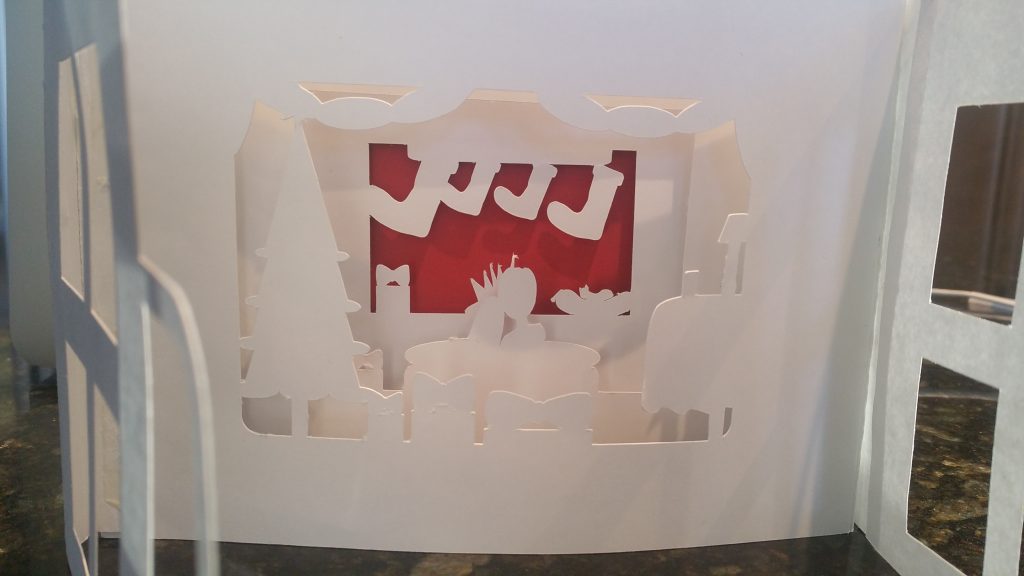
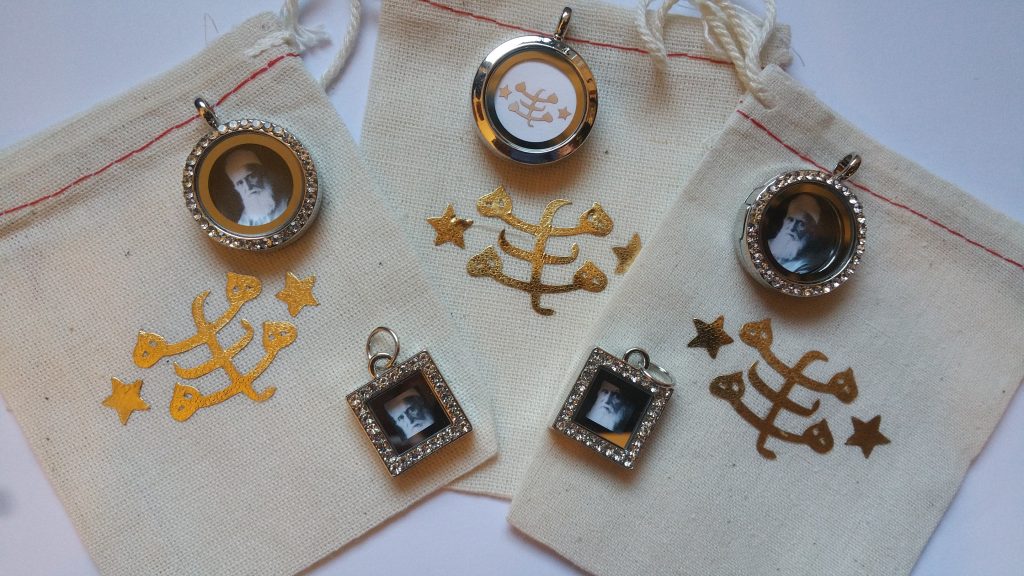
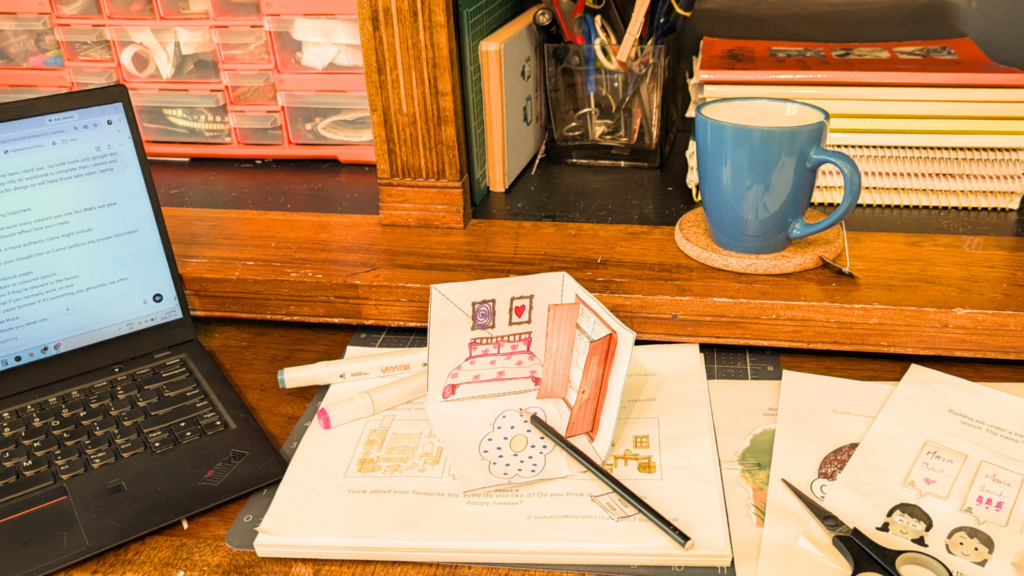
The Hands-On Connections bring another kind of creativity into the process because the ideas can actually be made, tested and photographed.
The postcard was a relaxing project, with its colouring and simple creative process.
The thaumatrope was much more experimental. Several versions were made while trying different image combinations and seeing which ones created the best effect.
There is something particularly satisfying about developing a physical activity this way. An idea can look good on paper, but sometimes it needs to be made before it is possible to know whether it really works.
That process of making, testing, changing and trying again is one of the most exciting parts of creating the resources.
What Was Learned Along the Way
Every workbook brings its own learning experience.
Part of that comes from thinking about whether the activities are enjoyable and educational, but there are also questions about what will actually make sense to the children using them.
The Think About It questions in this lesson were sometimes challenging to develop. Thinking about how a particular question might connect with a nine-year-old is not always easy when that age is many years in the past. That is an ongoing part of developing a better understanding of what might make sense for Grade 3.
Another lesson from this workbook was that even when a story strongly lends itself to one particular type of activity, there can still be many ways to approach it.
A lesson may contain so much information that the first response is frustration: How can this be presented without simply asking children to write the information down again?
But that frustration can also be the beginning of the creative process.
A sequence does not have to look like every other sequence. Information can be searched for, arranged, visualised, illustrated or approached through a different kind of activity.
Sometimes the first idea is simply a place to begin.
And sometimes, after leaving a page for a while and returning to it later, a new idea appears that makes the whole thing click.
That is one of the things that makes creating these resources so enjoyable.
A Free Activity to Try
One of the interesting things about developing a lesson is seeing how a story can lead to questions and activities that aren’t necessarily part of the main workbook.
For Grade 3 Lesson 12, one of those ideas became a simple journey activity.
What if you had to go find Bahá’u’lláh? How would you prepare? What would your journey look like? How would you find Bahá’u’lláh?
The page gives children space to think about how they would prepare, what they would take with them, places they might visit, people they would ask for help, how they would recognise Bahá’u’lláh, and anything else they would like to record.
This activity is available as a free resource if you’d like to explore the lesson in a more personal and imaginative way.
Exploring the Complete Lesson
If you’d like to explore Grade 3 Lesson 12 more fully, the complete set of JustusCrafting resources includes:
The Báb Enrichment Workbook — Understand the Lesson