
When I create resources for a lesson, I always want to give children different ways to approach what they are learning. I want them to have opportunities to read, think, draw, write, interact, move, build, observe and discuss.
For me, that isn’t something I decide to do for one particular lesson. It’s part of the way I approach creating resources.
Grade 3 Lesson 9: Jesus was no different.
As I worked through this lesson, I looked at each part and asked the same questions I ask when creating any lesson resource.
What belongs in the workbook?
What would work better as something children could physically manipulate?
And which ideas could become a demonstration, creative activity or hands-on experience?
The result became three connected resources:
Enrichment Workbook — Understand the Lesson
Interactive Components — Interact with the Lesson
Hands-On Connections — Experience the Lesson
Each one grew out of the same lesson, but each has a different purpose.
And, as usual, getting from the original idea to the finished resources took quite a bit of work.
Building the Enrichment Workbook
When I work through a lesson, I don’t simply try to fill pages with different types of activities.
I go through the lesson page by page and ask questions.
Is this something the children may never have experienced themselves?
Is there something in the story that needs to be made more concrete?
Would drawing make sense here?
Would writing help them think about the idea?
Could this become a sequencing or matching activity?
Would a puzzle or problem-solving activity fit?
And then there is the little Think About It box.
Sometimes deciding what belongs there is surprisingly difficult.
Drawing is always an easy option — when all else fails, draw something! — but I don’t want variety just for the sake of saying there are lots of different activities.
I want the activity to have a reason for being there.
The Jesus Enrichment Workbook ended up including drawing, writing and reflection activities, along with sequencing, matching, puzzles, review and problem-solving activities.
Some pages come together quickly.
Others don’t.
There are still pages where I look at them and think, Is this really the best way to approach this idea?
That’s part of creating.
Sometimes you have to live with a page for a while before you know whether it has actually landed where you want it to.
Then I Start Looking for Movement
Once the workbook is taking shape, I revisit the lesson pages.
This time, I’m asking a different question:
Could this idea become something children can actually move?
There are only so many simple paper mechanisms that teachers can realistically prepare for a children’s class.
I can make complicated things. I actually enjoy figuring out how complicated mechanisms work.
But the teacher preparing for class may have a completely different question:
“How much time do I have to prepare this?”
That matters.
So when I create Interactive Components, I’m looking for that balance — something interesting enough to give the children a reason to interact with it, but practical enough that it can actually be used in a children’s class.
No Room at the Inn
The idea for No Room at the Inn came from thinking about how some children may never have experienced what it is like to be looking for somewhere to stay.
The workbook already gives them an opportunity to think and write about being welcoming.
For the interactive version, I wanted something they could physically reveal.
That became a pull-tab activity.
The hope is that the simple movement helps the children remember the story of Mary and Joseph arriving in Bethlehem and not finding a suitable place to stay.
Preparing the Way
Some ideas almost tell you what the mechanism should be.
The original lesson activity involved a plant pot, a watering can and the question:
What is one good quality you would like to grow in your heart?
As soon as I saw that, I could picture a pull-tab plant growing and a watering can moving.
Of course, getting the idea to actually work was another matter!
At one point I realised I hadn’t created anything at the back to keep the pieces from simply fluttering around.
So I added a pocket for the moving pieces.
That’s one of those little details nobody sees when they look at the finished activity — but it is part of getting from “That would be cool” to “Okay, this actually works.”
A Message of Love
This one changed along the way.
I wasn’t particularly happy with my original approach, so I went looking for a different way to make the page interactive.
I liked the idea of something that could close up neatly but then open into a larger space for the child’s response.
That led me to the Turkish Map Fold.
When closed, it is compact. When opened, it provides much more room for drawing or writing about ways to show care or forgiveness.
I also included a Simple Fold option for anyone who wants an easier construction method.
The Turkish Map Fold takes a few more instructions, but I found this quick and easy video demonstration helpful when I needed to refresh my memory.
Seeing with the Heart
This was probably the mechanism that took the most persistence.
I wanted the child to have a little surprise when the page opened.
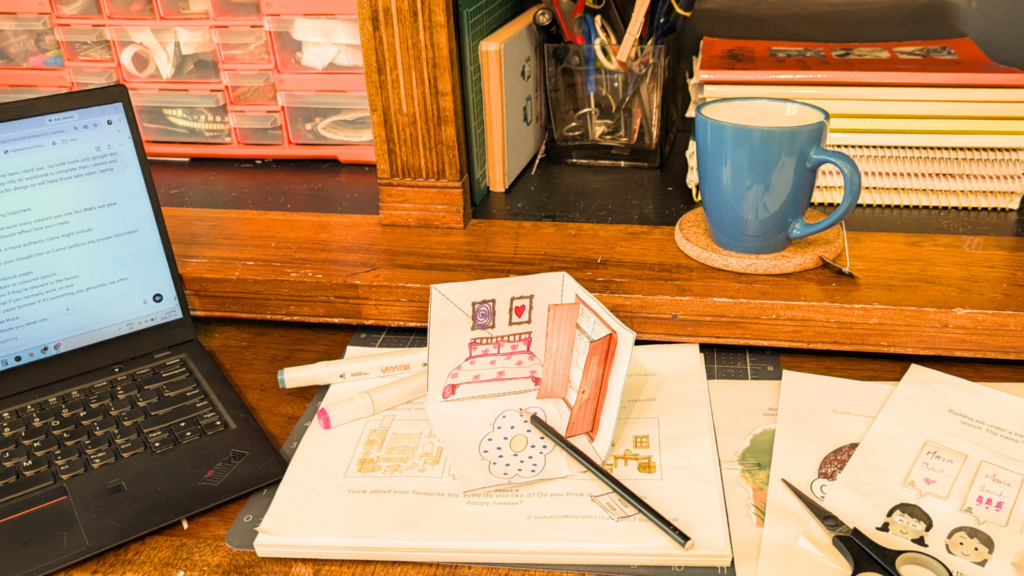
Instead of leaving the activity completely flat, I wanted it to open into a three-dimensional box-like structure.
Getting that mechanism to work properly took a lot of attempts.
Probably twenty or thirty tries before I was satisfied that it worked well enough to explain in instructions.
But this is one of those times when the work was worth it.
I love how it fits onto the page, opens up, and creates that unexpected three-dimensional effect.
The movement gives the children something to explore while connecting with the lesson’s idea of seeing with the heart.
And that is really what I am looking for when I create these.
Not movement simply because movement is fun.
Movement that has a reason.
Taking the Lesson Off the Page
This is where the Hands-On Connections come in.
I’ve always enjoyed using props and demonstrations when teaching children’s classes.
If there is an idea that might seem abstract to a child, I start wondering whether there is something they can actually see or experience.
For example, if we are talking about attracting hearts, could a simple science demonstration show attraction in a way that children can see?
That’s why I love finding science connections when they make sense.
And the Ruhi books also include opportunities for drama and movement that can sometimes be overlooked.
Children moving around isn’t necessarily just getting their wiggles out.
Sometimes the movement itself can help them experience an idea from the story.
Walking Around the Sea of Galilee
One of the stories describes Jesus walking around the Sea of Galilee for three years.
For a child, three years can be a difficult amount of time to picture.
So I wanted to turn that idea into movement.
Depending on the available space, children can walk around their space multiple times — perhaps 20 or 30 times.
It doesn’t recreate three years, of course.
It simply gives them a physical way to think about repetition, time and continuing to walk day after day.
Who Is My Neighbour?
The story of the Good Samaritan gives us another opportunity to stop and think about what it means to be a good neighbour.
This is a subject I care about personally.
I believe strong neighbourhoods and communities are built when people are willing to notice one another, help one another and care about what happens to the people around them.
So I wanted this activity to give children an opportunity to think about what makes us decide to help someone who needs assistance — and why the Samaritan chose to help someone from a group with whom there was conflict.
A Rock That Stays Firm
Some ideas can be demonstrated with very simple materials.
A Rock That Stays Firm uses wet and dry paper and a rock to explore what happens when a foundation is strengthened.
It is a small demonstration, but it gives children something they can actually observe while thinking about the idea of having a strong foundation.
Seeing More Than Our Eyes Can See
This object lesson came from wanting to make the idea of spiritual sight a little more concrete.
Children can look directly at something without immediately noticing what is there.
Then, when they pay attention, they suddenly see something they hadn’t noticed before.
That simple experience creates an opportunity to talk, think and reflect on seeing beyond what is immediately obvious.
And Then There Are the Creative Connections
The Hands-On Connections also gave me room to create things that children could actually make and hold.
Spiritual Sight Glasses was one of those ideas I couldn’t resist.
I had seen the idea on Pinterest and immediately thought it could work beautifully with the lesson’s idea of spiritual sight.
So I adapted the concept into a printable creative activity where children can make their own interactive “Spiritual Sight” glasses.
There is something satisfying about creating something with your hands and then actually being able to hold it when you’re finished.
The Spiritual Sight: Blind Man Can See activity takes another approach, using a small pull mechanism that changes the eyes from blank to eyes with pupils.
And then there is Loaves and Fishes: There Is Enough to Share.
For this one, I deliberately focused on the very practical idea of food and sharing rather than trying to make it into something more complicated.
The mechanism allows the fish to move up and down.
It’s different.
It’s hands-on.
And sometimes that’s enough.
More Than Three Weeks Later…
These Jesus resources have been in development for more than three weeks.
And, honestly, I don’t consider a project finished when the last activity is created.
There are instructions to check.
Mechanisms to test.
Photographs to take.
Templates to make sure work properly.
Pages to look at again.
Covers to design.
Payhip listings to write.
And then, finally, the artwork for the products.
I spent hours each day working on these resources while still trying to manage everything else that makes up an actual life.
Work.
Volunteering.
Entertaining.
Caring for my family.
Not necessarily in that order!
There is always something else that needs doing.
So when I finally finish the artwork and look at the three resources together, there is a definite feeling of:
Okay. Now it’s finished.
Why Do I Keep Doing This?
There is a very practical question behind all of this:
Why do I spend so many hours creating these resources?
My sister-in-law has asked me why I do it.
Even my daughter has even told me, “Don’t do it.”
but my answer is always the same:
I enjoy doing it.
I love finding different ways for children to approach learning.
Not every child connects with a lesson in the same way, and I love being able to give them choices — reading and writing, drawing, solving a puzzle, moving something, building something, watching a demonstration, or simply stopping to think about an idea.
But there is another part of this that matters just as much to me.
The Teachers
The people teaching children’s classes are often volunteers.
They have their own work, families, responsibilities and busy lives, and yet they are willing to dedicate part of their weekend to preparing for and teaching a children’s class.
I want to support them.
If they are going to give their time to the children, I want to give them quality materials that enrich the lesson and make preparation a little easier.
I don’t want the resource to replace the teacher.
Quite the opposite.
I want the teacher to be the hero.
The one standing in front of the children.
The one watching them get excited about an activity.
The one hearing their questions.
The one seeing the connections being made.
The one guiding the discussion and bringing the lesson together.
And yes — hopefully the children are already thinking:
“When is the next class?”
But I also want the teacher to feel like a hero when the parents see what their children have been doing and hear what they have been talking about.
Because behind every children’s class is a volunteer who gave their time to make it happen.
If I can help make that job a little easier, give them quality materials, and provide different ways for the children to engage with the lesson, then the hours I spend creating these resources are worth it.
That’s why I keep doing it.
Grade 3 Lesson 9: Jesus Resources
The finished collection brings the lesson together in three different ways:
Understand the Lesson — Enrichment Workbook
Explore the lesson through reading, discussion, drawing, writing, reflection, sequencing, matching, puzzles and review activities.
Interact with the Lesson — Interactive Components
Use pull tabs, folding mechanisms and interactive paper construction to explore selected lesson ideas.
Experience the Lesson — Hands-On Connections
Explore demonstrations, science connections, object lessons and creative projects connected to the lesson.
Together, they form the
Grade 3 Lesson 9 Jesus Complete Lesson Bundle:
Understand + Interact + Experience.