
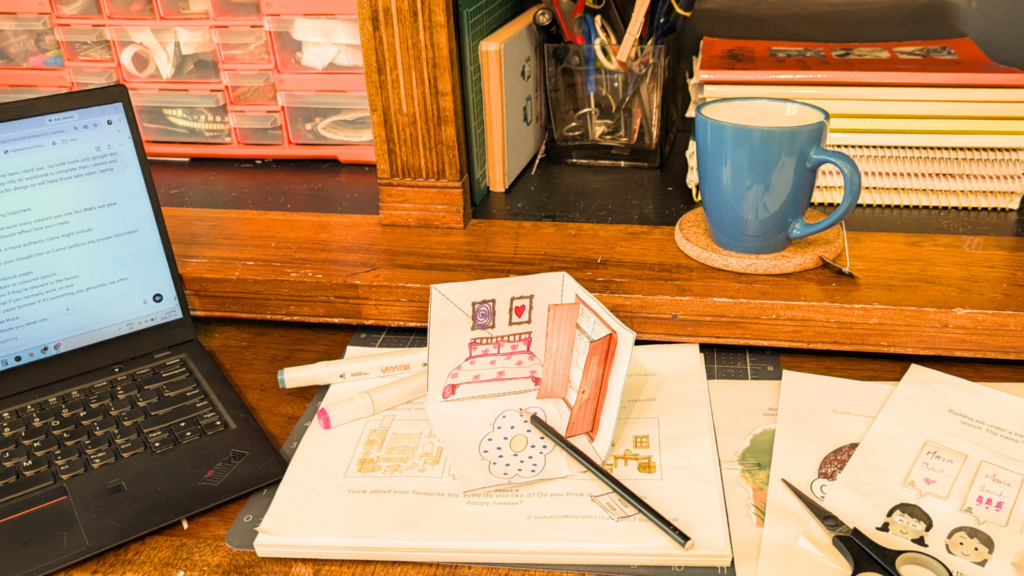
Wrap your fingers around a hot cup of tea. (I’m having cookies with mine… don’t tell anyone 😊.)
Let’s reflect on this lesson together.
As I’ve been spending time with Grade 3 Lesson 7, working on the enrichment workbook, one question has stayed with me.
How do we help children connect with someone who lived more than two thousand years ago?
As adults, life moves quickly. Our days are filled with responsibilities, family, work, and the unexpected challenges that come our way. History can easily become something we read about, appreciate, or even admire, yet still feel removed from our everyday lives. It can seem like something that happened long ago to people who lived in a very different world.
Children often do the opposite.
They instinctively wonder what those people thought, felt, feared, and hoped for.
Perhaps that’s why children don’t usually connect with dates or historical facts first.
They connect with people.
And maybe that’s where we should begin too.
Children are naturally drawn to stories of hope and fear, courage and kindness, questions and the search for truth. Those experiences are timeless. They remind us that although the world has changed, the human heart hasn’t changed nearly as much as we sometimes think.
The story comes first
Working through this lesson meant returning again and again to the story itself. Before activities, worksheets, or interactive pieces could take shape, one question guided every decision: “What is this story really inviting children to explore?”
The answer wasn’t simply to explore events from long ago. It was to create opportunities for children to encounter a person who saw suffering in the world and began searching for answers. Children naturally recognize compassion, curiosity, and the desire to help when something isn’t right. Those are experiences they already understand.
When we begin there, the story starts to feel much closer.
Helping the story come alive
Children approach a story in many different ways, each shaped by their own personalities, experiences, and interests.
Some are drawn into discussion.
Others through drama or role play.
Some by creating something with their hands.
Others through art, music, or simply sitting quietly and reflecting.
This enrichment workbook is simply one of those pathways.
It is offered as another tool to help volunteers engage children thoughtfully with the lesson, but it isn’t the lesson itself. Every volunteer brings unique gifts, creativity, and experiences to their class, and meaningful learning can happen in many different ways.
Every child finds a different doorway
It’s always a delight to watch children engage with the same story in different ways.
One child may connect through conversation.
Another through drawing.
Another through building, acting, or quietly reflecting.
There isn’t one right doorway into a story, and perhaps that’s part of what makes teaching children so special. Each child discovers the story in their own way, often noticing something that no one else in the class has seen.
Hope within the story
Lesson 7 introduces children to suffering, which isn’t always an easy topic to explore.
But perhaps children don’t need to be protected from every difficult idea.
Children already know that sadness, illness, disappointment, and loss exist.
What they need is hope.
This story doesn’t leave us in suffering. It introduces someone who responded to suffering by asking important questions and searching for a better way. That response—the desire to understand and to help—is something children can carry into their own lives.
Walking alongside one another
If you’re teaching this lesson, I hope these thoughts encourage you.
Whether you use the enrichment workbook, adapt ideas of your own, or simply sit together and have meaningful conversations, what matters most is helping children encounter the story as something living rather than distant.
Perhaps, as children connect with the people within these ancient stories, we’ll find ourselves connecting with them too.
After all, we don’t connect with history because it’s old.
We connect because it’s human.
Related Resource
If you’d like to explore the activities inspired by this lesson, take a look at the Grade 3 Lesson 7 Enrichment Workbook.